

From a city pilot to a regional blueprint: What Gdynia's bulky-waste strategy could mean for the Baltic Sea Region
Date
Thu, 09/10/2026
GDYNIA, POLAND, JUNE 2026
As the European Commission moves toward its long-awaited Circular Economy Act later this year,
the Polish port city of Gdynia raises a question increasingly hard to avoid: can a local pilot initiative
turn into infrastructure an entire region can share? Since November 2023, this question has been
explored within Creative Circular Cities (CCC), a €3.98 million project co-funded through the EU's
Interreg Baltic Sea Region Programme.
Over the past three years, the Baltic Sea Region fostered collaborations between six municipalities
involved in the European project Creative Circular Cities: Gdynia (PL), Aarhus (DK), Kiel (DE), Riga
(LV), Tallinn (EE), and Turku (FI). The purpose was to explore how creative industries, communities
and local authorities can rethink the way in which cities relate to the resources they already have.
From restoration workshops to intensive courses for students and businesses, the project provided
frameworks for experimentation and knowledge sharing towards a more sustainable, circular
economy in the cities and in the region. In Gdynia, this work focused on the EU's
least-documented waste streams: bulky waste.
Eurostat folds bulky waste into a broad "other" category of municipal waste, together with textiles,
batteries and electronic equipment, a group that accounts for roughly 34 million tonnes, or about
14.5% of all EU municipal waste, with no further public breakdown by individual stream. Several
member states do not even run a full compositional analysis on this residual waste, meaning flows
like bulky items are not consistently separated out in national reporting.
In Gdynia, Pomeranian Science and Technology Park PPNT Gdynia and the “Pomorskie in the
European Union” Association set out to address this gap directly. The project partners started
mapping who in the city generates bulky waste and who could reuse it, while developing working
relationships between residents, designers and local businesses who would be able to give
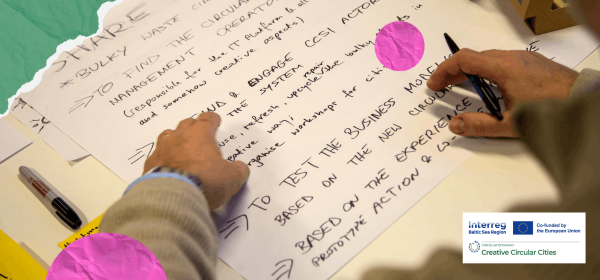
discarded items a second life. The result, a prototype of the circular bulky waste management
service "Podaj dalej - Share it", takes inspiration from Aarhus's UPCYCL scheme, which matches
industrial excess materials with companies that can put them to use. After testing the prototype
locally, the next step for the project’s team is to develop a dedicated guidance webpage for other
municipalities, making it easier for cities that look to replicate the approach and develop their own
platform for bulky-waste circulation.
"Bulky waste is probably one of the clearest opportunities cities have to practise circularity without
waiting for new infrastructure. Our goal was never simply to divert more items from disposal — it
was to understand how designers, businesses, residents, and public and cultural institutions could
work together to keep these materials in circulation, adapt them, and repurpose them in creative
ways," says PPNT Gdynia Design Centre representative Urszula Kasińska.
"What Gdynia has been testing locally is part of a much larger question the region is asking.
Through Creative Circular Cities, we are seeing how a single municipality's pilot, when
documented and shared, can become something other cities adapt rather than reinvent. That is the
kind of regional cooperation and transfer of learnings this project was built to support, with an eye
toward what scalability could look like at EU level," says Rafał Rolka, Project Coordinator at
"Pomorskie in the European Union" Association.
This is the conversation the project's Transition Lab was built for. Held in Gdynia this spring, the
gathering brought together partners from across the Baltic Sea Region for a session dedicated
specifically to replication and scalability, questioning whether pilot work built in one city can be
taken apart and rebuilt in another. With circular economy regulation, resource security and
cross-border cooperation all converging on the EU's policy agenda this year, the conversation
reflects a wider recognition: city-level experiments and continent-level policy are no longer
separate tracks.
Yet whether Gdynia's local practices can travel beyond the city's limits remains an open question.
While a pilot can prove an idea works, turning it into lasting practice depends on policy that goes
beyond the project itself: local commitments that keep partnerships active once funding cycles
end, and international frameworks that help cities build on each other's experiments rather than
start from zero each time. Gdynia's bulky-waste work is a useful case precisely because it makes
both sides of that challenge visible: what a simple, well-supported pilot can achieve, and how
much policy infrastructure still needs to be built around it before this kind of work becomes the
rule rather than the exception.
Behind these local efforts lies a bigger question: what finance model can circular initiatives actually
rely on, once EU project funding runs out? Circularity transition cannot be fully sustained and
encouraged as long as linear options remain the cheaper choice. And will there be investment in
the people skills the circular economy depends on? These are just some of the questions city
actors would be eager to see answered in the Circular Economy Act.
About Creative Circular Cities
Creative Circular Cities (CCC) is a transnational project co-funded by the Interreg Baltic Sea
Region Programme and the European Union. The project explores how culture and the creative
industries can help cities move from linear consumption to circular lifestyles. Across six Baltic Sea
Region cities, Gdynia, Aarhus, Kiel, Riga, Tallinn and Turku, CCC develops and tests tools, models
and local activities that connect circular economy with creativity, citizen engagement, business
development and policymaking.
In Poland, CCC is implemented with local partners including PPNT Gdynia Design Centre and the
“Pomorskie in the European Union” Association.
Media contact:
Laura Gundega Kristapsone, Communications Manager
Creative Circular Cities, Danish Cultural Institute in Estonia, Latvia and Lithuania
Email: lgk@danishculture.co